
Harlaxton Manor — Architecture as Composition
There are some buildings you admire, and there are others that become part of your imagination. For me, Harlaxton Manor has been the latter.
I first discovered the house when I was fifteen, through Mark Girouard’s The Victorian Country House. For the next thirty-seven years it remained one of those places I knew through photographs and drawings, yet had never experienced in person. Yesterday, I finally walked through its gates.
It was, quite simply, extraordinary.
What struck me first was the approach. One of the things that makes Harlaxton so captivating is that the experience begins long before you reach the house itself. The drive dips and rises through the landscape, alternately revealing and concealing the building. A gatehouse provides the first architectural punctuation, followed by the enormous Baroque gate piers. Beyond them, the house begins to emerge through the trees.
And then it rises.
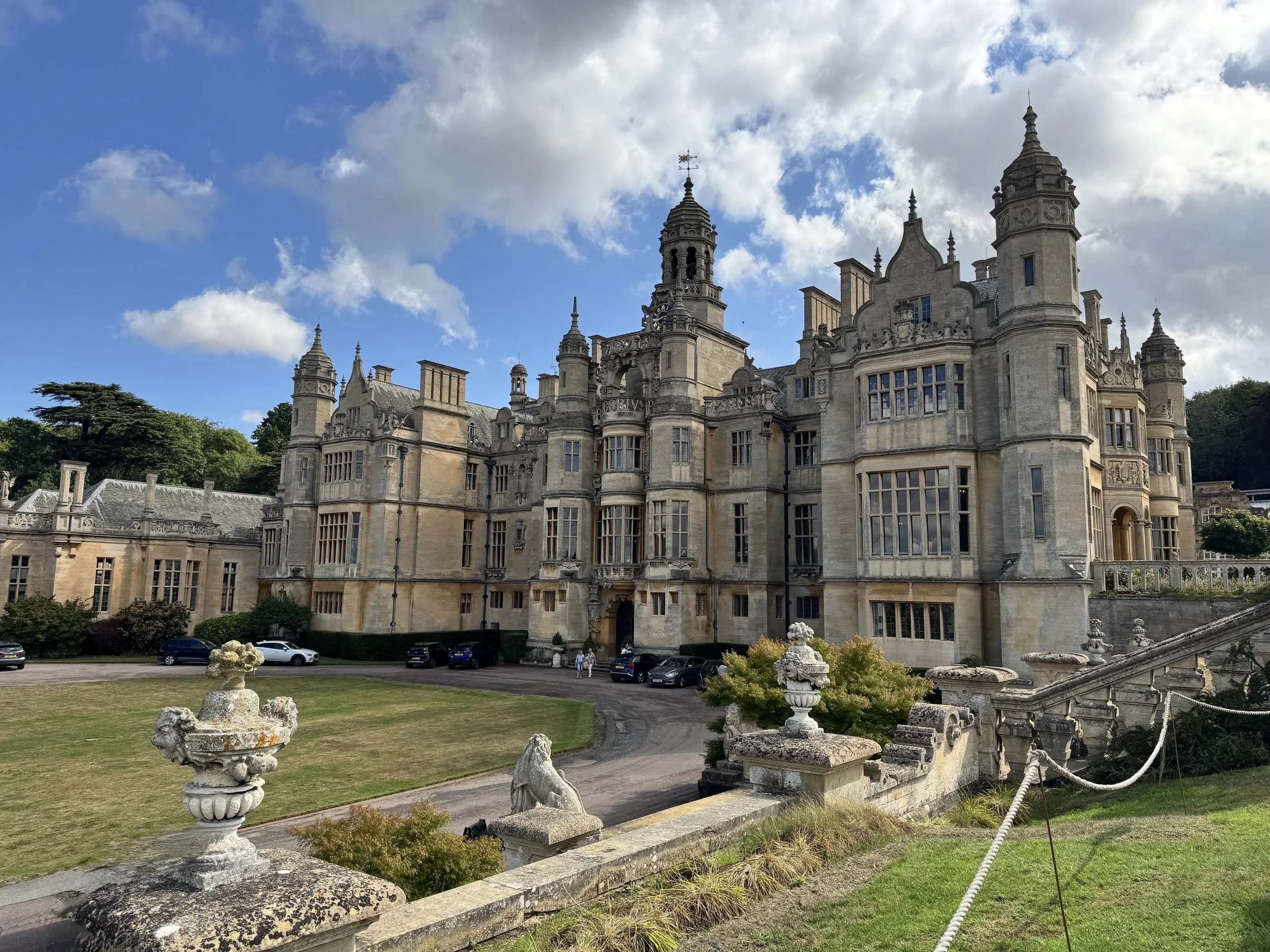
Harlaxton is set into the hillside almost as though it has been nestled into the landscape. Yet because it occupies an elevated position, the house becomes progressively more imposing as you approach. Even from a distance it is never completely revealed. There is mystery before there is majesty.
That sense of anticipation is not accidental. The approach creates a sequence of views, moments and thresholds. The house is not simply an object placed within a landscape; it is something experienced as a journey.
When the entrance front finally reveals itself, the effect is spectacular. Its extraordinary symmetry gives the building a remarkable sense of harmony, despite its exuberant fusion of Elizabethan, Jacobean and Baroque ideas. On paper, the combination seems almost impossible. Yet somehow it works.
Indeed, this is one of the reasons Harlaxton remains my favourite large country house. It is flamboyant, theatrical and highly individual, but it is also an exceptionally pleasing composition. There is a sense that every part belongs to the whole, even when the architectural language is deliberately extravagant.
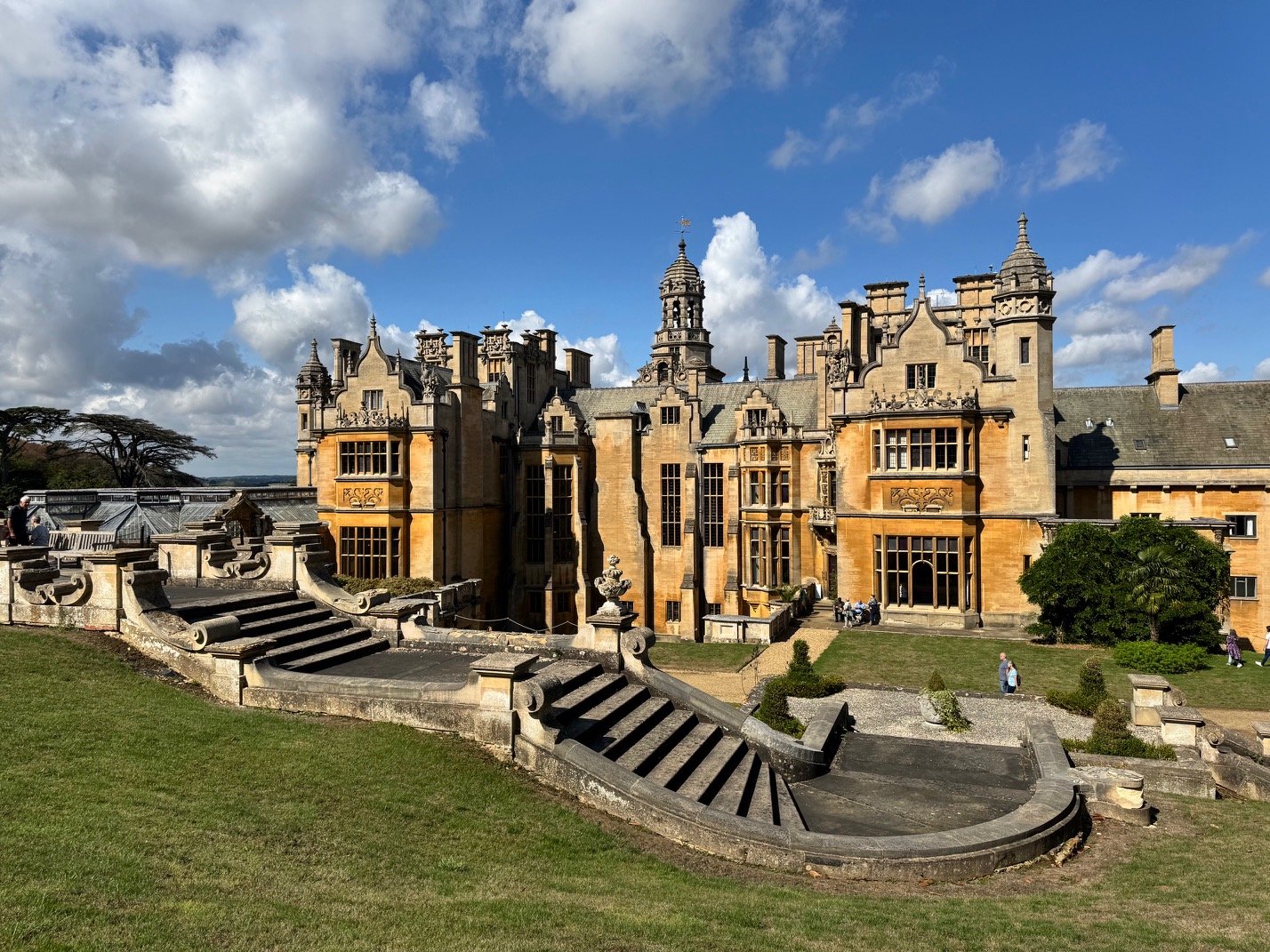
The garden front offers something quite different. Gables, turrets, chimney stacks and beautifully proportioned mullioned and transomed windows create an animated and almost picturesque elevation. At the rear, the formal symmetry gives way to something much more playful as the house wraps around the Great Hall. Changing rooflines, unexpected windows and architectural details appear almost as discoveries. The house continually reveals another side of itself.
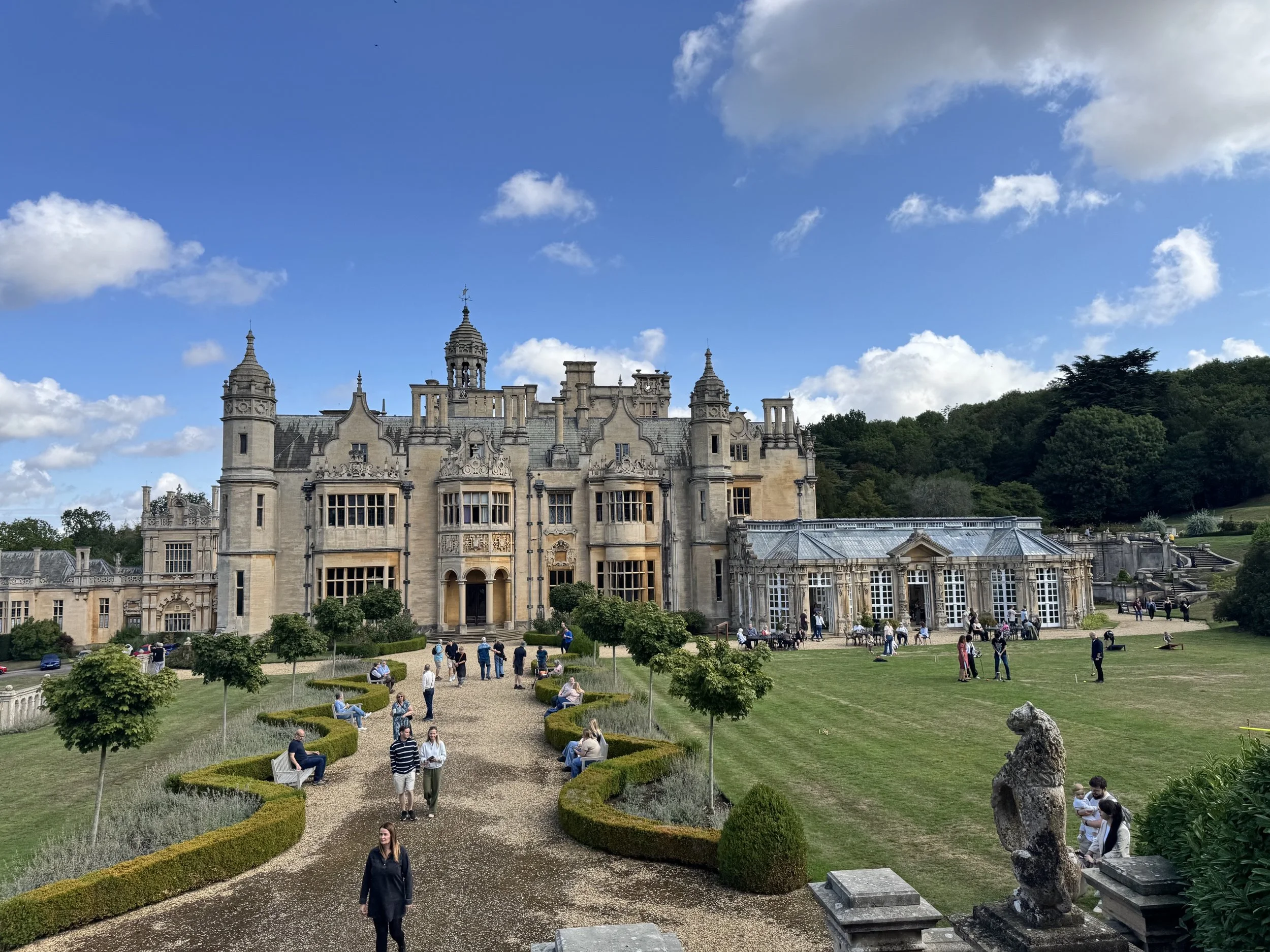
The stonework deserves particular attention. The dressed stone is exceptional, with tiny mortar joints and beautiful variations in colour and striation across the elevations. It is something photographs struggle to communicate. The honey-coloured stone changes character depending on the light, with subtle variations appearing across the surface as shadows move throughout the day.
I was particularly struck by the relatively simple walls within the entrance porch. You arrive through ornate doors, yet the walls immediately around them are comparatively plain. After the exuberance of the exterior, there is a moment of visual quiet. A breather.
And it is precisely in that quieter moment that the quality of the stone becomes apparent. Sometimes richness comes not from adding more, but from knowing where to stop.
The same principle can be seen in the way the house choreographs movement. The entrance porch creates compression. The processional route then carries you upwards before the scale suddenly expands as you enter the enormous Great Hall, creating a powerful sense of release. The house doesn't simply show itself to you; it reveals itself to you.
This is something I find particularly fascinating in architecture. Scale, proportion, sequence, threshold, light and material can all be used to create an emotional response without the need for anything to be explicitly explained. We experience architecture with the body as much as with the eyes.
Not everything worked for me. The famous Cedar Stair is undeniably impressive, but personally I found it overblown and almost too fantastical — closer to a theatrical stage set than the architectural cohesion I find elsewhere in the house. But perhaps that is also part of Harlaxton’s fascination. It isn't afraid to be itself.
Gregory Gregory’s creation was a lifelong project: an extraordinary act of ambition, imagination and, undoubtedly, ego. Whether driven by a love of art and architecture, a desire to create something remarkable, or simply the pleasure of bringing his vision into being, the house has an unmistakable sense of authorship. You can feel the person behind it.
And I rather suspect I would have got on with him.
There was also one moment during the visit that surprised me. Walking through the gardens and seeing the house from the rear, with its rambling roofline, chimneys and gables, I experienced an extraordinary sense of déjà vu. It reminded me of a recurring dream I had as a child — a dream about a house that looked remarkably like this.
I actually got goosebumps.
I showed my friend my arms because the sensation was so strong. For a moment, the house felt strangely familiar. Almost like coming home.
Perhaps that sounds fanciful. But after carrying an image of Harlaxton in my imagination since I was fifteen, finally standing there was an unexpectedly profound experience. Sometimes a building can become so deeply embedded in your imagination that encountering the real thing feels less like discovering somewhere new and more like finally arriving somewhere you already know.
There is also a sobering side to Harlaxton’s story. The house was eventually saved from demolition for £78,000 — a substantial sum at the time, but a figure that today would barely buy a modest house. Its survival was by no means inevitable.
Hundreds of Britain’s great country houses were lost in the decades following the Second World War, taking with them extraordinary examples of craftsmanship, architecture, landscape and social history. It is easy to look at Harlaxton today and assume that a building of such importance must always have been protected.
It wasn't.
There is much more to Harlaxton than I have described here: the terraced gardens, the extraordinary interiors, the Great Hall and even the miniature railway constructed to transport coal around the estate. But perhaps the best way to understand a house like this is not through photographs or descriptions.
It is to visit.
To walk the approach. To experience the changing light on the stone. To pass through the thresholds. To feel the compression and release. To look up. And then to look again.
After thirty-seven years of knowing Harlaxton through a book, I finally experienced the real thing.
Some buildings live up to the imagination.
Very occasionally, they exceed it.
Harlaxton did.