
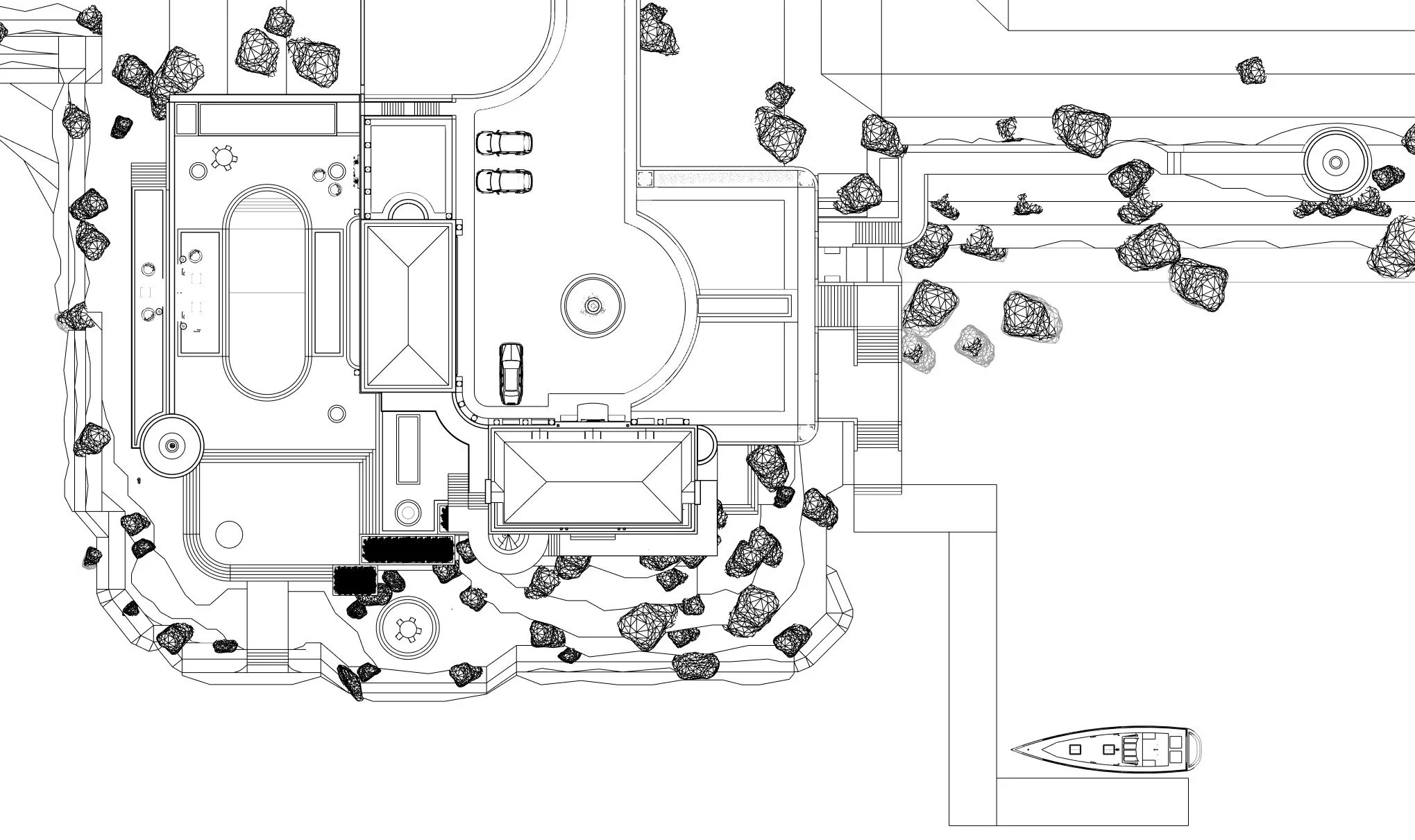
Design Study no.1 - Headland House
I don’t design in stages.
For me, feeling, form, function and imagination are not separate parts of a process that happen one after another. They are happening together, continually informing and adjusting one another as the design develops.
A floor plan is never simply a floor plan. A change to a wall can alter the way light enters a room. Moving a stair can change circulation, which can affect the proportions of the rooms around it. The position of a window might influence the placement of furniture, which in turn affects how a room is experienced. A kitchen layout can change the relationship between the kitchen, dining and living spaces. Nothing exists entirely on its own.
This is why I find a staged approach to design difficult. If the architecture is resolved first, the interior fitted afterwards and the decorative decisions made later, there is a risk that each layer is being asked to accommodate decisions that have already been made elsewhere.
Instead, I hold the different parts of the design in dialogue.
I might be considering the overall proportion of a house while simultaneously thinking about the width of a circulation route, the position of a piece of furniture, the quality of light in a room or the way a particular material will sit against the architecture. One thought can trigger another. A small adjustment at one level can reveal a much better solution somewhere else.
That doesn't mean every decision is made at once. It means nothing is considered in isolation.
I hold a space in my mind and test it continuously. How does it feel to enter? How does it move? Does the layout make sense? Does the proportion feel right? Where does the eye settle? What happens when the light changes? Does the furniture belong there, or is the room asking for something different?
The process is iterative, but it isn't linear. Decisions are made, tested, challenged and sometimes reversed. A solution that seemed right at one point can reveal a problem elsewhere, and that problem can lead to a better solution than the one originally intended.
This is particularly important when designing connected spaces. A kitchen cannot always be considered simply as a kitchen. Its relationship with the dining space, the garden, the entrance, the utility, the living areas and the circulation through the house may be just as important as the cabinetry itself.
The same applies to furniture. A piece isn't successful simply because it looks right in isolation. Its scale, position, material and relationship with the surrounding architecture all contribute to whether it belongs.
The same thinking applies to detail. I don't see the detail as something added at the end to finish a design. It should emerge from the larger idea. A door opening, a junction, a change in material or the alignment of architectural elements can all reinforce the same underlying structure.
There is a point where the process begins to resolve. Not because everything is finished, but because nothing interrupts the whole.
The eye doesn't catch on a misplaced element. There isn't a detail demanding attention simply because it hasn't been resolved. Movement feels natural. Proportions feel balanced. Materials belong together. The functional requirements are working without having to announce themselves.
The space simply holds.
That moment is important to me because good design shouldn't need constant explanation. When everything is working together, the result can feel almost inevitable. It becomes difficult to imagine the space having been arranged any other way.
For me, design isn't a sequence of decisions. It is a process of alignment. Feeling, form, function and imagination are continually brought into relationship until the different parts stop competing and begin to belong to the same whole.
Nothing is separate. Nothing is paused. The whole design is in dialogue with itself.
Explore how this thinking is applied across residential interior design services.